













Plinko for Real Money in Australia
On this page about Plinko for real money, you'll learn how to play with a realistic bankroll plan, clear limits, and an appropriate choice of rows and risk levels. We'll explain step-by-step what risk profiles exist, how to assess deposit and withdrawal options, and what pitfalls many players overlook. The goal is for you to approach Plinko Casino as entertainment, with pre-determined limits instead of impulsive decisions.
Plinko for Real Money: Basic Principles and Expected Value
When you play Plinko Casino for real money, the experience transforms from a simple demo game into a game of chance with a fixed house edge. Each drop of the ball is statistically independent, but the total outcome over 100 to 1,000 drops follows a predictable distribution. This means that in the long run, you'll get back less than you wager, even with an RTP of 97% or higher. The core idea is that rows and risk levels primarily change the shape of the distribution, not the underlying expected value. By accepting this beforehand, you avoid looking for strategies that mathematically have no effect on the probability structure.
For real money sessions, it's useful to work with a fixed bankroll in AUD and divide it into 100 to 200 units. For example, if you choose a bankroll of A$200, a unit size of 0.5% per drop means you're wagering approximately A$1 per drop. This allows you to play 200 to 400 drops without a few losing streaks immediately depleting your balance. This approach makes it easier to measure the impact of variance and prevents severe emotional fluctuations. This way, Plinko Casino remains a form of entertainment within pre-defined limits.
Bankroll Management for Real Money Play
Bankroll management is the most important factor determining whether you stay within your limits in the long run. A practical rule of thumb is to include at least 100 to 200 units in your session budget, where one unit corresponds to a single drop. If you play with higher volatility, for example, 16 rows and high risk, an even smaller unit of 0.3% of your bankroll per drop is advisable. Additionally, set a clear stop-loss level, such as a 10% loss per session, and an equally sized take-profit level. By setting these levels in advance, you prevent yourself from increasing your wager under the influence of emotions during a downswing.
Keeping a simple logbook per session helps to base decisions on facts rather than memories. Note your starting and ending balance, chosen settings, session duration, and how you felt during the game. After a few weeks, you'll see patterns in your behaviour and can better adjust limits and unit sizes to your tolerance for fluctuations. Players who regularly analyse this data report less regret afterwards and have more control over their playing rhythm. This way, bankroll management becomes an active steering tool instead of a theoretical concept.
Risk Levels and Rows: Impact on Session Progression
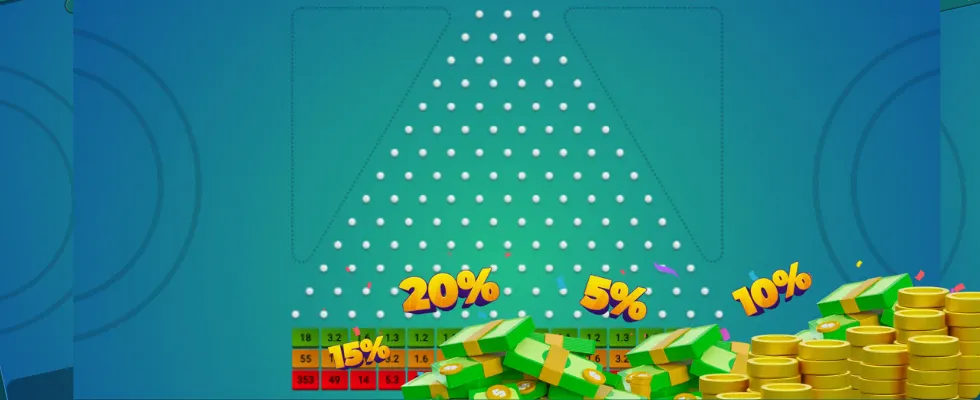
The choice of rows and risk level determines how widely the outcomes of your sessions are spread. With 8 to 10 rows at low risk, most outcomes are close to the wager, with relatively many small hits in the middle of the board. With 16 rows at high risk, a larger portion of the expected payouts shifts towards the edges, making session results much more erratic. This means you can experience longer dry spells, interspersed with sporadic high multipliers. It is therefore wise to explicitly define your risk profile before you start a Plinko Casino board with real wagers.
Instead of constantly changing settings during the game, it's more efficient to test three fixed configurations beforehand: low, normal, and high risk. Play 200 to 300 drops per configuration in demo mode and note how often you experience drawdowns of 20% or more. If a certain setting consistently feels too stressful, remove it from your repertoire. This creates a personal set of configurations that suits your balance and mental capacity. This approach makes your Plinko Casino sessions more predictable and prevents impulsive switching between extreme settings.
| Configuration | Rows | Risk | Typical Swing | Recommended Unit | Suitable Session Length |
|---|---|---|---|---|---|
| Conservative | 8–10 | Low | ±5%–15% | 0.5% per drop | 100–200 drops |
| Balanced | 12–14 | Normal | ±10%–25% | 0.5%–0.75% | 150–250 drops |
| Aggressive | 16 | High | ±20%–50%+ | 0.3%–0.4% | 200–300 drops |
| Stepwise | 12 | Normal | ±15%–30% | 0.5% per drop | 200–250 drops |
| Short Sessions | 10 | Low | ±5%–20% | 0.75% per drop | 80–150 drops |
The table shows that higher rows and risk levels directly lead to larger fluctuations in your balance. This may seem attractive when chasing a big hit, but it also increases the chance of deep drawdowns within a single session. By choosing a smaller unit for aggressive configurations, the absolute impact of each swing remains manageable. Combine this with fixed session limits and evaluate only after multiple blocks of hundreds of drops. This way, you use the configurations consciously instead of reactively.
Practical Bankroll Examples
- Bankroll A$100: wager A$0.50 per drop, 200 drops per session, and a stop-loss of A$10.
- Bankroll A$200: wager A$1 per drop, blocks of 150 drops, and a result limit of -A$20 or +A$20.
- Bankroll A$300: wager A$0.75 per drop with 12 rows normal risk, maximum 250 drops per block.
- Bankroll A$150: wager A$0.60 per drop, two sessions of 120 drops with a minimum two-hour break in between.
- Bankroll A$250: wager 0.5% per drop, daily playtime limited to 30 minutes to prevent impulsive decisions.
- Bankroll A$400: wager A$0.40 per drop with 16 rows high risk, strict loss limit of A$30 per session.
Payment Methods for Real Money Play
When playing with real money, the choice of payment methods is at least as important as the game settings themselves. Legal providers in the Netherlands and Belgium primarily work with iDEAL, Bancontact, bank transfers, and sometimes e-wallets, while crypto payments are almost always linked to offshore providers. For you, this means that transactions via regulated channels offer the most protection and clarity. Always check the minimum deposit, minimum withdrawal, and any fees per method before your first deposit. This prevents you from being surprised later by limits or extra charges.
| Method | Min. Deposit | Min. Withdrawal | Avg. Withdrawal Processing | Notes | Suitable for |
|---|---|---|---|---|---|
| iDEAL | A$10–A$20 | A$20–A$25 | 1–3 business days | Standard in NL | Regular Players |
| Bancontact | A$10–A$20 | A$20–A$25 | 1–3 business days | Standard in BE | BE Players |
| E-wallet | A$10 | A$20 | Up to 24 hours | Additional KYC for large amounts | Experienced Players |
| Bank Transfer | A$10–A$25 | A$20–A$50 | 1–3 business days | Transparent in statements | Budget Tracking |
| Credit Card | A$10–A$20 | A$20–A$50 | 2–5 business days | Potential cash advance fees | Only Experienced Players |
The table shows that payments via iDEAL, Bancontact, and bank transfers are sufficient to fund normal Plinko sessions. Speed is important, but it should not come at the expense of an overview of your total monthly spending. Therefore, choose a method you also use outside the casino so that you see all expenses in one financial overview. Avoid methods that combine tempting speed with unclear costs or limited consumer protection. This way, you keep your Plinko budget clear and manageable. For players who primarily play on mobile, it's also useful to check out the Plinko app and mobile page.
Legal versus Offshore Providers
The distinction between legal and offshore providers is crucial when you want to play Plinko Casino with real money. Legal Dutch and Belgian operators fall under Ksa and KSC respectively, with mandatory CRUKS registration and EPIS links, and strict advertising restrictions. Offshore platforms often advertise high multipliers, crypto payments, and limited KYC, but do not offer a local complaints desk. For you, this means that disputes over payouts, limits, or account closures are more difficult to enforce. The combination of financial risks and lack of oversight means that legal alternatives are practically safer, even if the bonuses seem less spectacular on paper.
Review research shows that complaints about unpaid balances and blocked accounts disproportionately often come from offshore contexts. With legal operators, there are clear paths for escalation, including dispute resolution bodies and supervisory authorities. When you play Plinko Casino with a licensed provider, you also know that advertisements and bonuses are subject to legal frameworks. This reduces the chance of misleading claims about "risk-free" play or guaranteed winnings. Therefore, consciously choose legal providers and use offshore information at most as a technical reference, not as an invitation to play.
Responsible Gaming with Real Money
Responsible gaming begins with clear limits around time and money, even before you drop the first ball. Set a monthly entertainment budget separate from fixed expenses and savings, and divide this into sessions of, for example, 20 to 30 minutes. Use the casino's limit tools to set deposit, loss, and session limits, so you are not solely dependent on self-discipline. Additionally, schedule fixed break times, especially after a big win or loss, to prevent emotions from guiding your decisions. These elements together form a practical framework in which Plinko Casino remains a controlled activity.
Tools such as reality checks, voluntary temporary exclusion, and permanent self-exclusion via CRUKS or EPIS are designed to support you when limits are under pressure. Players who make timely use of these options often report that they are later glad they made that choice. It is therefore wise to take signals such as chasing losses, lying about gambling behaviour, or neglecting other obligations seriously. If necessary, consult anonymous helplines or online self-assessment tests to get a more objective picture of your situation. Responsible gaming is not a restriction of enjoyment, but a way to prevent entertainment from turning into problem behaviour.
Payouts and KYC Procedures for Winnings
When you want to withdraw winnings from Plinko, you will almost always undergo a KYC process where your identity and payment method are verified. This process is mandatory under anti-money laundering regulations and protects both the casino and you as a player. On average, a full KYC check takes a few hours to a few days, depending on the speed at which you provide documents. For smooth processing, it is advisable to prepare copies of your ID, proof of address, and proof of payment in a timely manner. This prevents delays when you want to withdraw a larger amount.
It is important to understand that KYC is not a sign of distrust, but a legal obligation. Legal operators clearly explain in their terms and conditions which documents are required and how they are stored. Keep transaction IDs and confirmation emails for every withdrawal so that you have a complete trail in case of questions. Should a dispute arise, you can use this data to provide customer service and, if necessary, the regulator with concrete evidence. This way, the withdrawal process remains transparent and manageable for all parties involved.
Strategies and Pitfalls for Real Money Play
Common Mistakes
Although many players look for strategies to increase their chances, no betting pattern changes the underlying probability tree. Systems like Martingale increase the wager after a loss and can lead to rapid bankroll depletion in Plinko with high volatility. Fixed-unit strategies, where you wager a fixed percentage of your balance per drop, are statistically more stable. The true value of a "strategy" therefore lies in managing variance, not in generating structural profit. It is wise to test each system in demo first and only implement it if it fits within your limits.
Common pitfalls include chasing previous losses, increasing wagers out of frustration, and skipping planned breaks. These patterns mainly occur during long sessions with high rows, where swings are largest. By consciously keeping sessions short and evaluating results per block, you reduce the chance of emotion taking over. Combine this with fixed stop rules and a critical eye on promotions that encourage extra rounds. This way, Plinko Casino with real money remains a controllable activity within your personal framework.
F.A.Q
Ideally, work with a session budget of at least 100 to 200 units, for example, A$150 to A$300, and choose a unit size of 0.5% to 1% per drop to keep swings manageable.
Choose 8 to 10 rows with low risk and a fixed bet, for example, A$0.75 per drop. Play short sessions of 100 to 150 drops and then evaluate if the pace and variation suit you.
Many players use a stop-loss of about 10% of the session budget and a similar profit target. With a budget of A$150, that means stopping at -A$15 or +A$15.
Preferably use local bank transfers or e-wallets with licensed operators. These methods offer clear statements and fall under local consumer protection.
No, betting strategies do not change the probability distribution. Martingale mainly increases the risk of rapid loss spikes, especially with high rows, while fixed small units are statistically more stable.